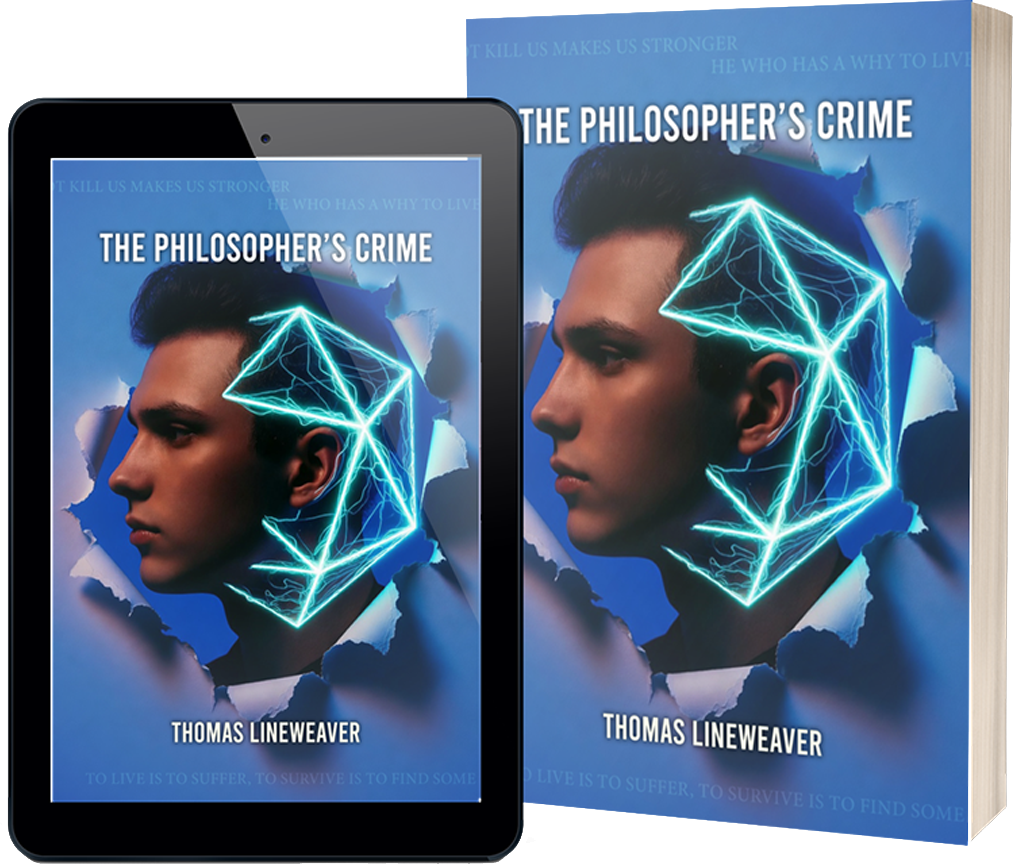
The Philosopher’s Crime

Available soon on Amazon!

About the book

Hi, I’m Thomas. I’m a freelance journalist, former podcaster, and now, somehow, a novelist. Releasing my first novel is both terrifying and exhilarating, but truthfully, it’s the most fulfilling experience I’ve had in years. Honestly, I’m deeply grateful to those who are supporting me in this effort to release my book. With that, I’d love to share what the book is about.

The Philosopher’s Crime is a queer romantic thriller that asks a dangerous question: what happens when the love of your life disappears and the only weapon you have is philosophy?

Gabriel “Gabe” Lyons, 26, first-year professor at Altmont College in quiet Clearfield, Pennsylvania, never expected his lectures on Plato and Nietzsche to become a matter of life and death. But when his boyfriend Ethan Carr vanishes—along with several others from the small college town—Gabe refuses to sit on the sidelines. Teaming up with Ethan’s estranged brother Caleb, student journalist Alex Chen, and a skeptical local detective, Gabe follows the trail straight into the grip of a secretive cult hiding in the hills around campus.

What begins as a missing-person case turns personal in ways Gabe never imagined. As the cult’s plan for violent revolt against the town and college draws closer, Gabe must weaponize the very ideas he teaches—turning moral philosophy into a last-ditch strategy to fracture their ideology from the inside before blood is spilled. In a rural America raw with division, one young gay philosopher discovers that some truths are powerful enough to save the people you love… and some ideas are lethal enough to get them killed.

If you love smart mysteries that wrestle with big questions, romances that earn every heartbeat, and page-turning suspense that doesn’t let go, The Philosopher’s Crime is waiting for you.

The Philosopher's Crime book cover

Favorite authors

Check out these authors ahead of the release!* These selections represent a small collection of works that have significantly influenced my writing and the creation of this book. I trust they will similarly inspire you.

Thomas Lineweaver is not responsible for external links on this website, working or broken. *Unless otherwise noted, all books are available through Barnes & Noble.

The Annotated Big Sleep

What it gave me

Chandler taught me how to make every sentence snap, how to let dialogue do the heavy lifting, and how a lone man with a code can walk through hell and still sound cool doing it.

How it shows up in “The Philosopher’s Crime”

Gabe’s voice, the dry one-liners under pressure, the way he sees through people—that’s pure Chandler filtered through a 26-year-old philosopher instead of a 1940s P.I.

To Kill A Mockingbird

What it gave me

Lee gave me my moral compass: the quiet rage at injustice, the belief that one person speaking truth can matter, and the understanding that real courage isn’t loud.

How it shows up in “The Philosopher’s Crime”

The heartbeat of the book—the refusal to stay silent when hate organizes—is straight out of Atticus Finch, only now it’s a queer kid from Pennsylvania staring down a cult.

The Unwanteds series

What it gave me

McMann showed me how to write fast, addictive chapters that still carry big emotional punches and how to make young characters feel powerful without being precocious.

How it shows up in “The Philosopher’s Crime”

The pacing, once Ethan disappears, and the team scrambles—that breathless, can’t-put-it-down energy—comes directly from binge-reading The Unwanteds as an adult and remembering how alive it made me feel.

The Killer Collective

What it gave me

Eisler handed me the blueprint for a ragtag crew of specialists forced to trust each other when the stakes skyrocket.

How it shows up in “The Philosopher’s Crime”

Gabe, Alex, Caleb, and Detective Naomi are my Killer Collective—different worlds, same desperate mission.

Cold Mountain

What it gave me

Frazier taught me how landscape can be a character and how love can be the quiet engine that keeps someone walking through war.

How it shows up in “The Philosopher’s Crime”

The Pennsylvania hills around Clearfield and Altmont College breathe the same aching air as Frazier’s Blue Ridge; Gabe’s love for Ethan is the same stubborn fire that kept Inman moving.

The Good Book

What it gave me

Gomes inspired me to question and explore ideas about ethics, tradition, and meaning without fear or apology.

How it shows up in “The Philosopher’s Crime”

Every time Gabe dismantles the cult’s twisted worldview with clear-eyed reason, you can feel the influence of Reverend Gomes’s thoughtful, open-minded approach supporting him.

True Lies

What it gave me

Her work demonstrates that every character, regardless of background, deserves dignity and depth, which reinforces the importance of equality in storytelling.

How it shows up in “The Philosopher’s Crime”

By refusing to flatten identities or rely on clichés, Margaret’s influence ensures that all voices are valued and represented authentically.

The Hero with a Thousand Faces

What it gave me

Campbell handed me the skeleton key: the monomyth. Refusal of the call, crossing the threshold, the belly of the whale, atonement with the father, return with the elixir.

How it shows up in “The Philosopher’s Crime”

Gabe’s entire journey follows the hero cycle beat for beat, only his “magic weapon” is philosophy instead of a sword.

The Lincoln Conspiracy

What it gave me

Meltzer proved you can mix real history, pulse-pounding stakes, and ordinary-people heroism without ever feeling gimmicky.

How it shows up in “The Philosopher’s Crime”

The way secrets from the past bleed into the present cult-crisis—that conspiratorial chill is pure Meltzer.

The Hit

What it gave me

Baldacci showed me how to keep the tension dialed to eleven across hundreds of pages and still land every emotional heartbeat.

How it shows up in “The Philosopher’s Crime”

The final confrontation with the cult-ticking clock, impossible odds, one shot to get it right—that relentless forward drive is Baldacci’s gift to me.