
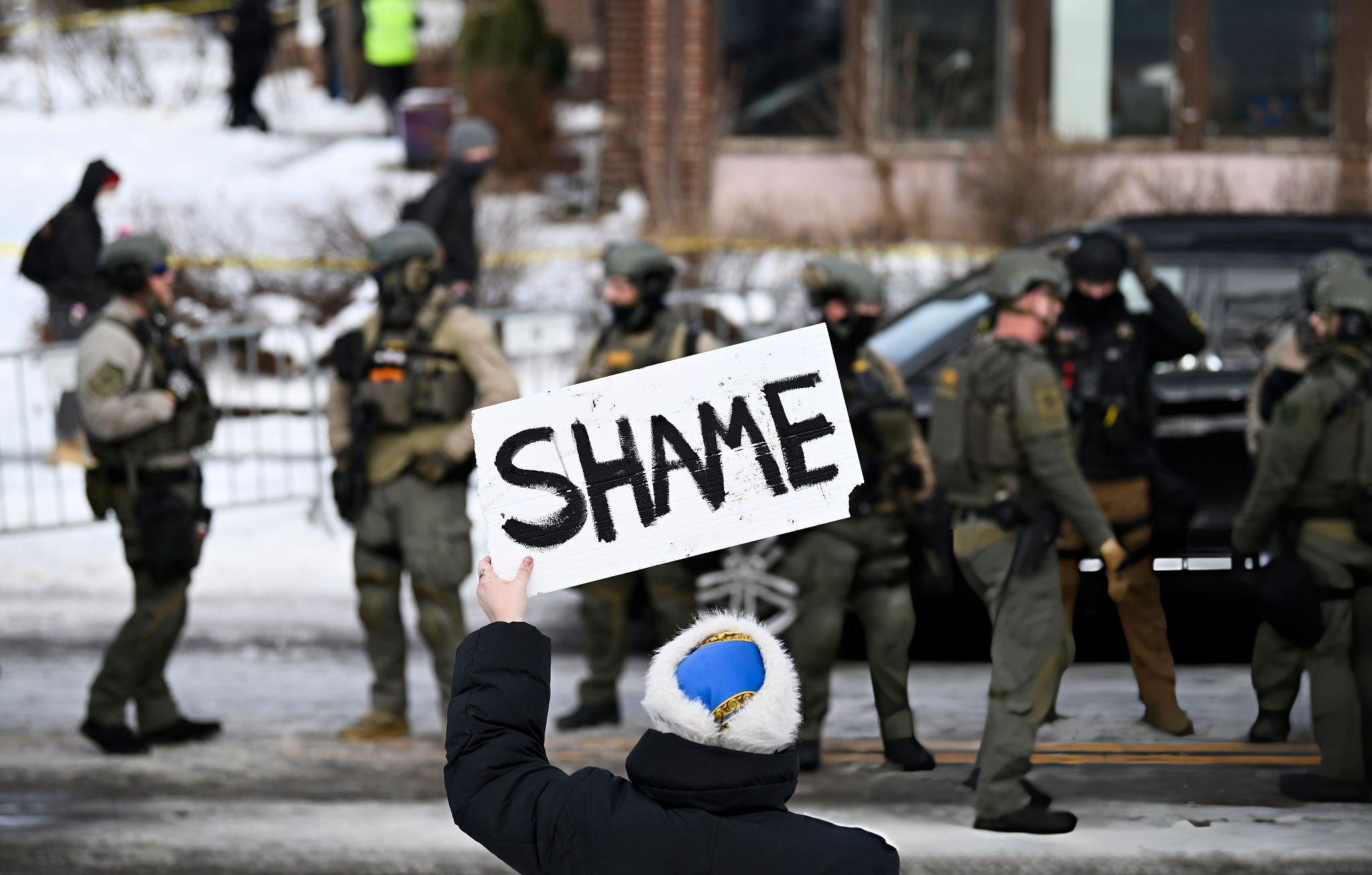
A week has passed since the tragic events of Wednesday, January 7, unfolded in Minneapolis, Minnesota. A normal day turned grim, yet anger and community outrage are uniting people.
What happened to Renee Nicole Macklin Good in Minneapolis is not just another entry in a crowded news cycle; it is a breaking point in the public conscience, and for many people, a breaking point in their faith that federal power will restrain itself before it kills a citizen.
The official narrative says an ICE agent fired in self‑defense at a “violent” rioter who weaponized her car, but the videos and eyewitness accounts tell a different, quieter horror: a slow‑moving SUV, a confused mother trying to navigate conflicting commands, and an officer who pulled the trigger three times through her windshield.
What makes this so unbearable is that, on paper, this should have been impossible. Immigration and Customs Enforcement insists it is governed by strict rules, that force is a last resort, that there are layers of oversight to prevent exactly this kind of lethal encounter with an unarmed U.S. citizen. Yet a 37‑year‑old mother of three was shot in the head in her own neighborhood, and the country is left parsing frame‑by‑frame video, trying to decide whether the front bumper of her Honda Pilot constituted a capital crime.
There is a chasm between the assurances Americans are given about federal law enforcement and the reality that played out on a Minneapolis street.
The facts, as we know them, are stark. ICE agents were conducting an operation in south Minneapolis, deploying a tactical team more commonly associated with high‑risk raids than with a blocked lane on a residential avenue. Renee Good, a citizen and local resident, ended up in their path. Her SUV was stopped and partially obstructing the street. Instead of being waved around or ticketed, ICE trucks boxed her in. Agents approached with guns and shouted overlapping commands: get out of the car, drive away.
It is hard enough for anyone to obey a single clear instruction in a moment of panic; it is nearly impossible to obey two contradictory ones while armed officers scream and reach through your window.
It is here that the official story and the recorded evidence diverge most sharply. Homeland Security rushed out a statement portraying Good as a would‑be killer who “weaponized her vehicle” against officers, language that deliberately echoes the imagery of terrorist truck attacks.
That framing, repeated uncritically in some political circles, does more than just justify a split‑second decision; it retroactively constructs a narrative in which any forward motion of her car becomes aggression, any hesitation becomes malice. Yet careful analysis of the videos shows a vehicle rolling slowly, steering to the right—away from the agent who fired—just seconds before shots shattered the glass. The law has always recognized that the perception of threat matters. But a democracy cannot allow “I felt scared” to become a universal permission slip for deadly force, especially when the visuals contradict the most extreme claims.
The moral injury here goes beyond the bullets. Neighbors watched a woman slump over behind a cracked windshield, blood pooling and streaking, while armed federal agents formed a perimeter—not around her to render aid, but around the scene to keep others away. Medical help did not rush in. Bystanders who offered assistance, including at least one medical professional, were rebuffed.
It is one thing to argue about the milliseconds before a trigger is pulled; it is another to explain why the person on the receiving end of that trigger is left without immediate care once the smoke clears. There is a basic human duty that transcends badges and jurisdictions: when someone is bleeding out in front of you, you try to save them.
What makes people furious, and what we can feel pulsing through our own words, is that this seems less like an isolated failure and more like the logical endpoint of a culture that has been taught to see certain lives as adversarial by default.
Renee Good was not an undocumented migrant. She was a U.S. citizen. She was a wife, a mother, a neighbor who sang and wrote and showed up for others. She also appears to have been involved in watching and documenting ICE activity, part of a loose network of citizens who keep an eye on immigration raids. For some in power, that alone is provocation. When a federal agency quietly internalizes the idea that community oversight is harassment and that critics are enemies, every interaction becomes a potential battlefield.
Layer onto this the politics of the moment. The country has watched as hard‑line rhetoric about immigration and “law and order” has escalated into almost messianic language about federal enforcement, with political leaders celebrating aggressive tactics and casting any constraints as weakness or betrayal. When a governor or a national figure positions themselves as the champion of “tough” enforcement and demands results, that pressure travels down the chain of command.
No one has to explicitly order an agent to shoot; it is enough to constantly signal that hesitancy is dangerous, that letting someone “get away” is failure, that vehicles are always potential weapons. Agents internalize that message. Citizens pay the price.
There is also a quieter, uglier suspicion that haunts this case: that the details of who Renee was made her more disposable in the eyes of those who confronted her. A queer woman. In a same‑sex marriage. Raising kids. Involved in immigration activism. Protesting or observing a federal operation. Those facts should never matter for how law enforcement treats a person, yet they often do, in ways that are rarely spoken aloud.
The pattern is familiar: the victim is first mourned, then dissected, then subtly criminalized. Her relationships, her politics, her presence on the street are held up as if they somehow explain why lethal force was “inevitable.” That is not accountability; it is narrative laundering.
What would accountability actually look like here? It would start with something that seems radical only because it is so rare: institutional humility. A public admission that the situation spiraled out of control. Full release of all video and audio from every angle, not just handpicked clips. A genuinely independent investigation, not a quiet internal review by colleagues who share training, culture, and incentives. Consequences that reach beyond one agent, examining how training, protocols, and political messaging combined to make a slow‑moving SUV feel like a mortal threat in broad daylight. It would mean revisiting the policies that placed heavily armed federal operators in the middle of a neighborhood in the first place.
More deeply, it would require a cultural shift in how the United States understands immigration enforcement itself.
For years, ICE has been allowed to operate in a moral gray zone, wielding immense power with minimal public oversight and only sporadic accountability. Many Americans have been willing to look away, comforted by the idea that as long as the crackdown is aimed at “others,” it does not endanger them. Renee Good’s death shatters that illusion.
The line between “them” and “us” is infinitely thinner than people like to admit. If a citizen driving through her own community can be shot dead during an immigration raid, then the apparatus built to police the border has, in a very real sense, crossed into everyone’s backyard.
There is nothing un-American about demanding that federal agents be held to the highest possible standard when they use deadly force. In fact, that demand is one of the few remaining guardrails between a government of laws and a government of fear. To accept what happened to Renee Good as an unfortunate but unavoidable incident is to say, implicitly, that some level of collateral damage is acceptable in domestic enforcement—that the rest of us can live with an occasional citizen’s death as the cost of “security.” That is a bargain no free society should strike, and certainly not in silence.
The anger I have described—the tears, the sense that morality is decaying, the feeling that “we are really screwed”—is not a weakness and not an overreaction. It is a sane response to a system that appears to have lost sight of the humans at the center of its power.
Grief and rage are not the end of the story, but they are an honest beginning. The question now is whether that emotion will be dulled by the next news cycle, or whether it will harden into resolve: to demand answers, to insist on reform, and to refuse to let the name of Renee Nicole Macklin Good be reduced to a line in a federal report.

Leave a Reply
You must be logged in to post a comment.